Undergraduate research · Senior-year thesis
Electromagnet for Cold Atoms
Design, modelling, fabrication, and magnetic-field measurements for a bias-curvature electromagnet for ultracold lithium-6 experiments.

Project Abstract
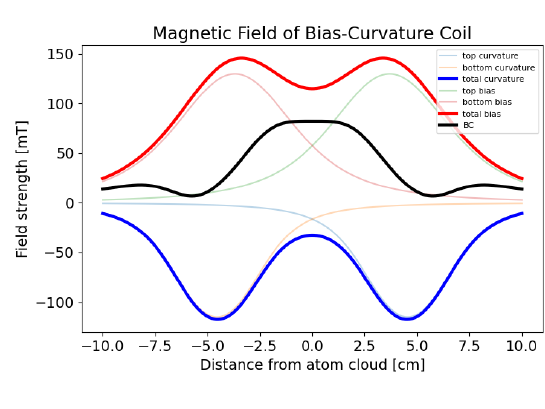
This undergraduate research project and my senior-year thesis at Yale-NUS College explored a Bitter-type bias-curvature electromagnet for ultracold lithium-6 experiments. The bias coils provide the strong magnetic field that tunes atom interactions, while the smaller curvature coils shape the field profile and can compensate its curvature.
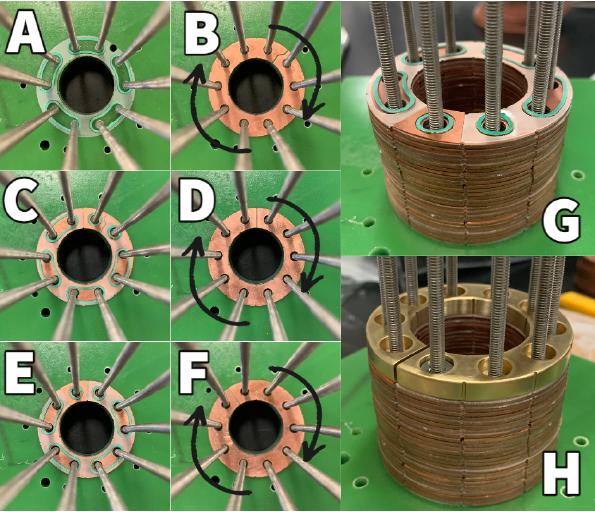
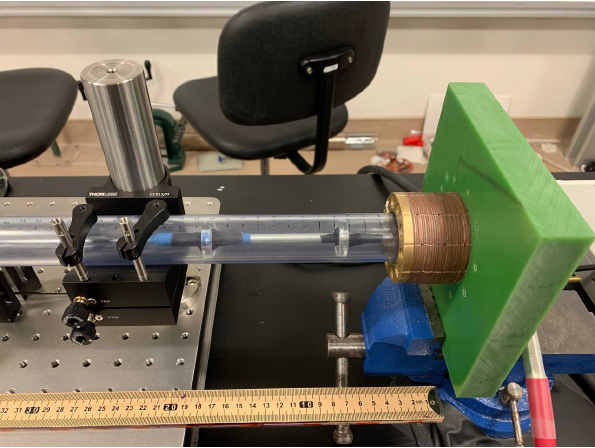
I used finite-element simulations to compare coil designs, then fabricated prototype coils and measured their magnetic-field profiles. These measurements supported a model of a strong, near-zero-curvature field, while full-power operation and the magnet’s cooling performance remained to be demonstrated.
Background And Motivation
Magnetic fields tune interactions in ultracold Fermi gases. The project was motivated by work studying transitions between dynamical phases in a quantum-degenerate Fermi gas.
Results And Next Steps
Finite-element simulations and prototype measurements supported a design for a strong, near-zero-curvature field. Full-power operation and cooling performance remained to be demonstrated.
Methodology
This undergraduate research project and senior-year thesis combined electromagnet design, finite-element modelling, fabrication, and magnetic-field measurements under the supervision of Dr. Ben A. Olsen.
Citations
Theoretical motivation: “Observation of a transition between dynamical phases in a quantum degenerate Fermi gas” by Smale et al. ↗. Thesis supervisor: Dr. Ben A. Olsen · Olsen Lab ↗.