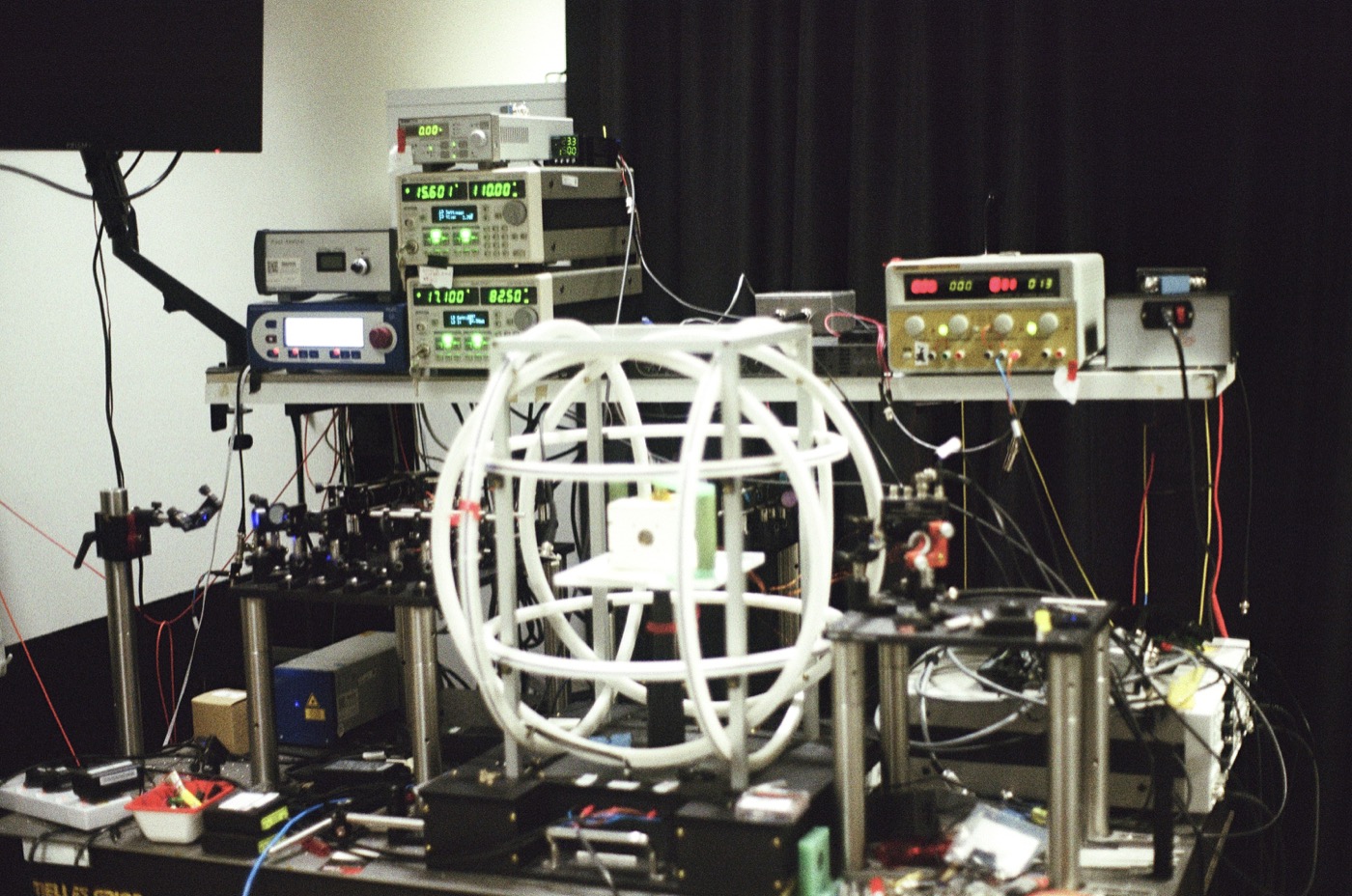
Alkali-vapour cells · Optical pumping
Hybrid Optical Pumping
Investigating how hybrid pumping behaves as the relative densities of two atomic species change.

Project Abstract
I designed an experiment to investigate and test common assumptions made about spin-temperature equilibrium in hybrid alkali-vapour cells. Hybrid pumping can increase the uniformity and sensitivity of atomic sensors.
We aimed to observe experimentally how the technique’s efficiency diminishes beyond a certain ratio of densities within a hybrid vapour cell. The longer-term goal is to improve vapour-cell uniformity and support more sensitive atomic magnetometers.
Background And Motivation
Hybrid pumping transfers spin polarisation between atomic species through collisions. It can improve pumping uniformity and sensor sensitivity, while its effectiveness may depend on the relative species densities.
Results And Next Steps
The experiment was designed to test how hybrid-pumping efficiency changes as the density ratio varies. The longer-term aim is to improve vapour-cell uniformity and support more sensitive atomic magnetometers.
Methodology
I designed an experiment to investigate assumptions about spin-temperature equilibrium and to observe the limits of hybrid pumping in a dual-species vapour cell.
Citations
Project-specific references will be added here.